Can Your Clients Say Why They Chose You? How to Communicate Your Value Proposition
Simple ways to put your strengths into words that stick.

Between the internet and AI, buyers and sellers can now find listings, home values, and rate quotes without picking up the phone. So when they do reach out, they want to know what you offer that a website can’t.
You likely already know your strength, whether it’s deep local knowledge, a financial background, fast response times, or a trusted team of pros behind you. The harder part is putting it into words that clients understand quickly, remember, and pass along to others.
The good news is that consumers still want an agent in their corner. According to NAR’s 2025 Profile of Home Buyers and Sellers, 88% of buyers purchased with an agent, and 91% of sellers listed with one.[2] What clients are really weighing is which agent to trust with one of the biggest decisions of their lives.

Some of the best guidance on this comes from outside real estate. StoryBrand founder Donald Miller and Made to Stick authors Chip and Dan Heath have spent years studying why some messages land and others get forgotten. Their ideas translate well to the conversations agents have every day. Here are three worth putting to work:

The Heath brothers found that concrete details make a message easier to remember and easier to believe.[3] Words like “experienced” and “dedicated” appear in almost every agent bio, so they tend to blur together. A number, a short story, or a recent result does more work. “I sold 12 homes in this subdivision last year” tells a seller far more than “neighborhood expert.”

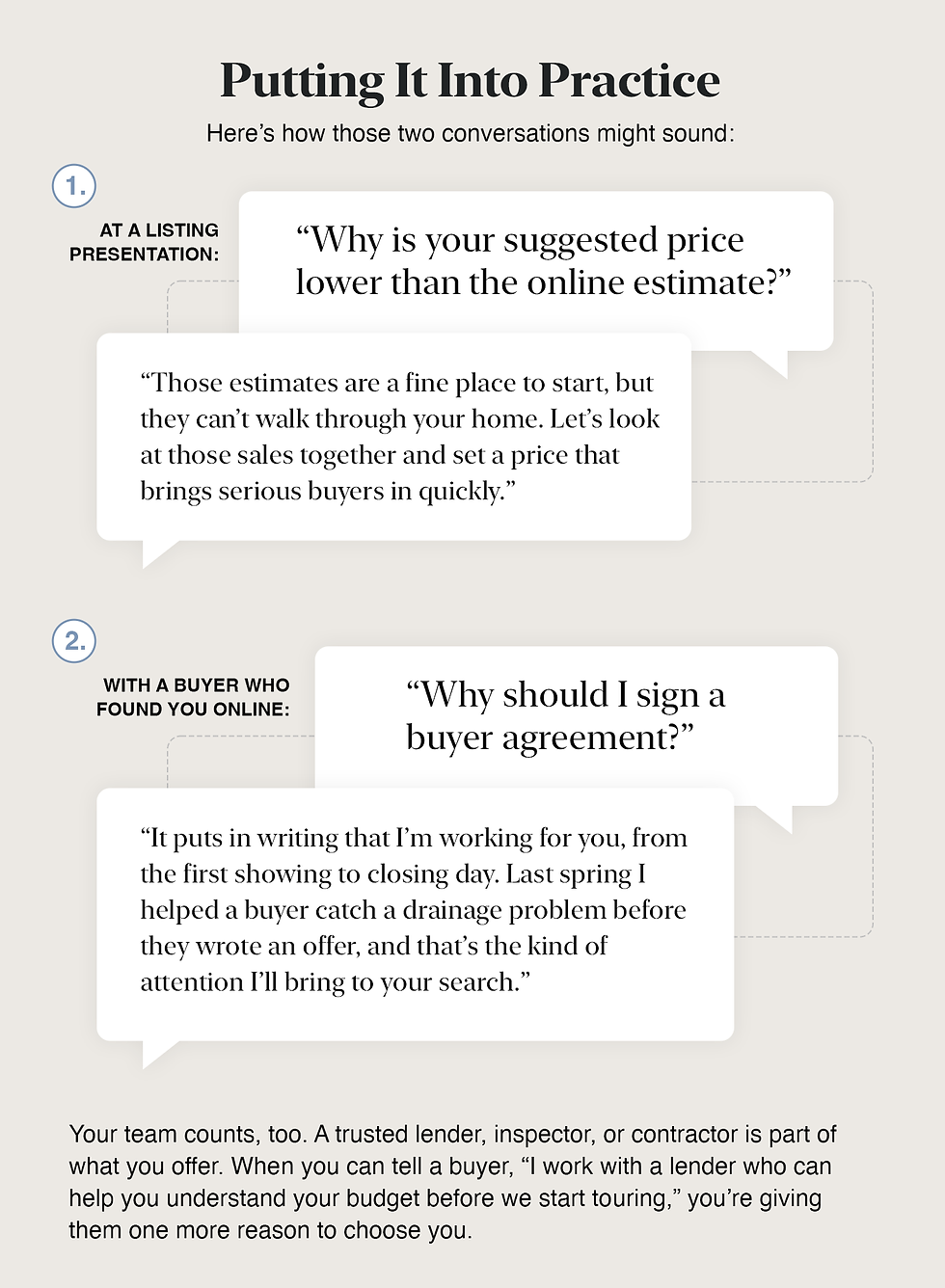
Miller’s StoryBrand framework puts the customer at the center of the story, with the business as the guide who helps them succeed.[1] For agents, that means answering the question the client is actually asking in that moment. Two you’ve likely heard:
At a listing presentation: “Why is your suggested price lower than the online estimate?”
With a buyer who found you online: “Why should I sign a buyer agreement?”
The best answers to these, and to any other questions you hear regularly, are short, honest, and memorable.

Nearly half of buyers (43%) found their agent through a referral.[2] Your past clients already know what you do. What helps them most is one clear reason you’re different, in words they can pass along to a friend. “She caught an inspection issue that saved us thousands” carries much further than “She’s a great agent.” When you lead with that same point in your own conversations, it gets easier for everyone to repeat.
EXPLORE FURTHER: What Is Your Unique Value Proposition?
Source:
Donald Miller, Building a StoryBrand: Clarify Your Message So Customers Will Listen, HarperCollins Leadership, 2017.
National Association of REALTORS®, “2025 Profile of Home Buyers and Sellers,” November 2025.
Chip Heath and Dan Heath, Made to Stick: Why Some Ideas Survive and Others Die, Random House, 2007.


Comments